
AIDIMME desarrolla «gemelos digitales» para potenciar los sistemas de depuración de aguas residuales
• La iniciativa DIGITUIN, financiada por el IVACE y los Fondos FEDER, impulsa un desarrollo para mejorar los procesos productivos mediante gemelos digitales, como es el caso de la central de depuración de aguas de Algemesí.
Los gemelos digitales (GD) son representaciones virtuales y dinámicas de sistemas, productos, o servicios, que permiten simular su comportamiento incluso antes de existir físicamente.
El Instituto Tecnológico AIDIMME está desarrollando un GD específico para una centrífuga de la central de depuración de Algemesí, gestionada por la empresa “Depuración de Aguas del Mediterraneo (DAM)”.
Esta máquina tiene la función de separar el agua del lodo líquido, obteniendo dos productos: agua y lodo sólido. El proceso se realiza rotando a gran velocidad el material introducido, consiguiendo así su separación.
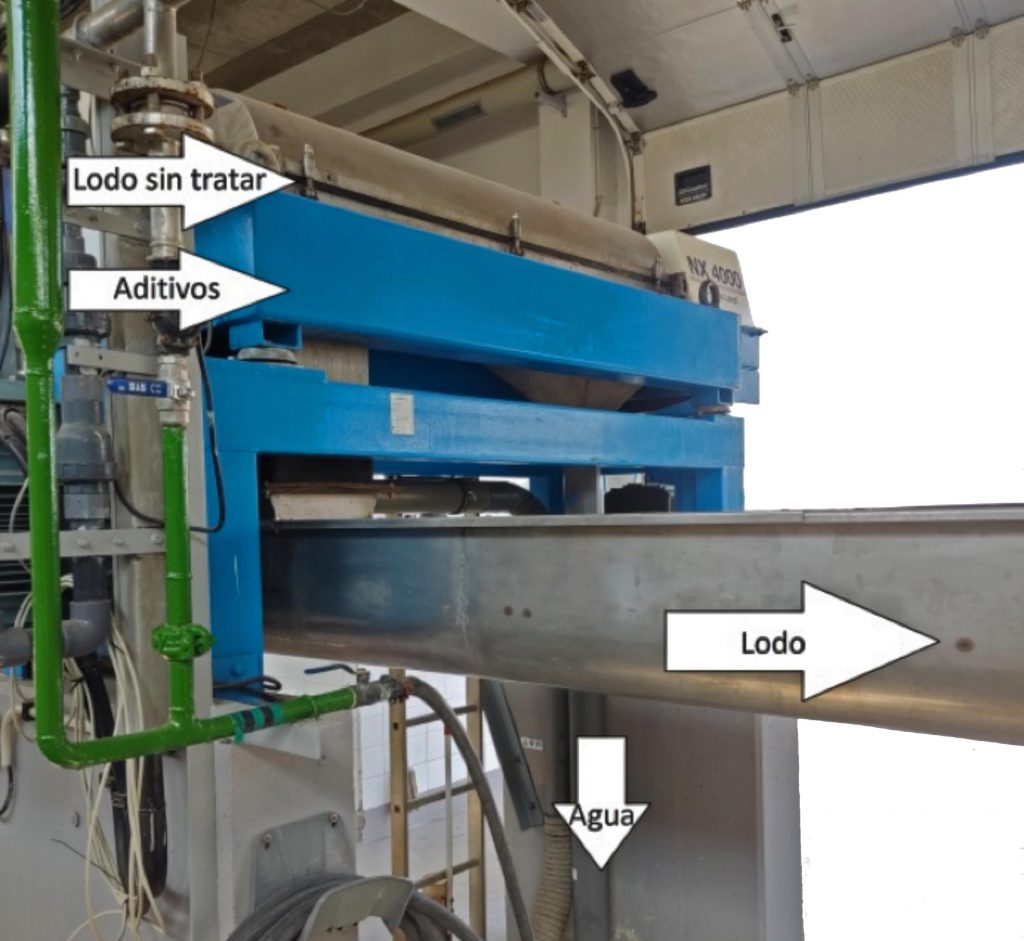
Real y digital
No resulta novedad destacar que el mundo real sufre de grandes carencias que no vemos en el mundo digital, por ejemplo, si una máquina se rompe, nos implicará una reparación costosa, mientras que si un programa se rompe se puede reiniciar a un coste similar a 0. El caso contrario también es cierto, un sistema digital no puede fabricar, mientras que un sistema físico sí.
El proyecto Digituin, “Desarrollo de una infraestructura digital para la construcción de modelos de procesos mediante gemelos digitales”, tiene el objetivo de conseguir un sistema híbrido que permita tener lo mejor de ambos mundos, y para ello se realiza una copia del sistema físico en el mundo digital.
El caso de uso elegido ha sido una centrífuga de la central de depuración de Algemesí, gestionada por la empresa “Depuración de Aguas del Mediterraneo (DAM)”.
Para obtener una copia digital de la centrífuga se están desarrollando dos pilares: la visualización y la algoritmia.
Para la visualización del gemelo se ha creado una copia en 3D del sistema, esto permite una interacción mucho más fluida con el sistema digital mediante realidad virtual. Se consigue de esta manera, una interfaz mucho más humana y una forma de interaccionar mucho más directa.
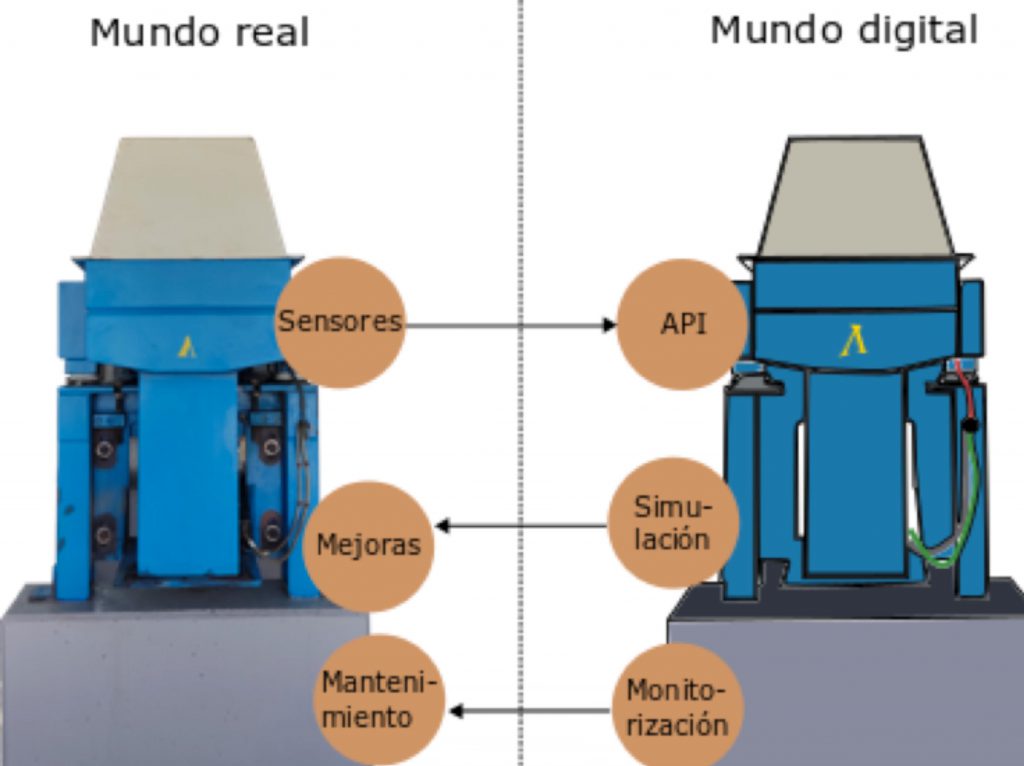
Para la parte algorítmica es necesario tener un feedback directo del estado real del aparato y de la relación que existe entre las distintas variables recogidas. Para esto se utilizan sensores que recogen en tiempo real diversas magnitudes como las vibraciones, la velocidad de rotación, la temperatura del lodo, o la corriente que está utilizando la máquina.
Una vez se mide los datos, estos son enviados a la API del gemelo que recibe, clasifica y almacena los datos.
La ventaja digital
Esta colección de información tiene 2 usos principales. El primero y más directo es la monitorización continua del sistema físico permitiendo optimizar los mantenimientos de la máquina y adelantar posibles averías.
Por otra parte, el modo de simulación genera modelos que permiten predecir el resultado de alterar las distintas variables de entrada, conduciendo de esta manera a diversas mejoras en la producción.


Número de proyecto: 22100064
Expediente: IMDEEA/2021/52
Duración: Del 01/07/2021 al 30/06/2022
Coordinado en AIDIMME por: SÁNCHEZ ASINS, JOSÉ LUIS
Línea de I+D: INDUSTRIA 4.0

Para más información contacte con AIDIMME.
Visitas: [wpstatistics stat=pagevisits time=total id=28390]
AIDIMME: proyectos en ejecución
- AIDIMME ya trabaja en los proyectos de apoyo a sus líneas estratégicas de I+D con apoyo de IVACE y la Generalitat Valenciana.
- Las acciones que iniciaron su ejecución el pasado mes de enero.
El IVACE y la Generalitat Valenciana apuestan un año más por las líneas estratégicas de I+D de AIDIMME con el apoyo a proyectos. Dichas acciones, como ya hemos mencionado, están enmarcadas en las siguientes líneas estratégicas:
LÍNEAS ESTRATÉGICAS DE AIDIMME
Economía circular
Estrategias orientadas a promover un cambio del modelo de gestión de residuos. Cambios en los modelos de producción y consumo que impliquen reciclar, reutilizar materiales y productos todas las veces posibles, aumentando el uso ecológico de los recursos, su ciclo de vida.
Fabricación aditiva
Desarrollo de soluciones tecnológicas basadas en fabricación aditiva, fabricación por adición también conocida por impresión 3D. El objetivo es transmitir nuestros conocimientos en materiales, tecnologías y aplicaciones industriales con un asesoramiento tecnológico personalizado, que facilite la implantación en la industria.
Desarrollo y Optimización de Producto
Nuevas técnicas y tecnologías para el Desarrollo de Producto adecuándolas a las necesidades industriales, productivas y de mercado actuales. Afecta a todo el proceso: diseño, oficina técnica, producción y comercialización, aplicando nuevos sistemas de diseño, cálculo, simulación, funcionalidades y conectividad (IoT).
Industria 4.0
Convertir a la empresa industrial en una organización inteligente que facilite información para la estrategia de negocio. Máquinas, cadenas de aprovisionamiento y distribución conectadas a través soluciones TIC, en una interoperabilidad eficiente, utilizando automatismos, sensores, actuadores y plataformas colaborativas.
Aplicaciones Avanzadas de los Materiales
Estudio y desarrollo de nuevas aplicaciones para materiales compuestos y modificados, buscando las actuales necesidades en cuanto a la reducción de peso, mejora estructural, resistencia al fuego, agua y a otras condiciones ambientales, con aplicaciones para todos los sectores empresariales.
Superficies Modificadas
Utilizando técnicas de polimerización por Plasma o nanotecnologías, entre otras posibilidades pueden modificarse las superficies. Con esta línea estratégica, conseguimos mejorar las características técnicas, la usabilidad, la durabilidad, la protección y de aspecto de las cosas que vemos y tocamos.
Toxicidad de Materiales
Inocuidad de los materiales, evitando los peligros asociados a la toxicidad de los productos que nos rodean. Evitar enfermedades, alergias o contaminación ambiental, controlando las migraciones en contacto alimentario, por contacto con la piel o por Componentes Orgánicos Volátiles COV.
Sistemas de Embalaje
Estudiamos la manipulación, transporte y almacenaje que todos los productos industriales tienen. Investigamos embalajes adecuados a cada sector y tipología de productos, analizando rutas completas, desde el origen hasta el destino cumpliendo además la normativa, la viabilidad y la sostenibilidad.
Biomateriales
Se desarrollan y caracterizan nuevos materiales innovadores de origen biológico, más sostenibles, con prestaciones mejoradas respecto a los materiales actuales y aplicaciones en los sectores objetivo (construcción tradicional, arquitectura pasiva y bioclimática, bioconstrucción). Se diseñan y desarrollan plataformas IoT/Smart Cities de sensores inalámbricos que permiten monitorizar la madera en obras de arte, obra nueva y edificios patrimoniales.
A continuación les mostramos los proyectos en ejecución ordenados por línea estratégica de I+D:
PROYECTOS EN EJECUCIÓN
- OSICV – Observatorio de Simbiosis Industrial de Comunidad Valenciana.

Número de proyecto: 22200013
Expediente: IMAMCA/2022/2
Duración: Del 01/01/2022 al 31/12/2022
Línea de I+D: ECONOMÍA CIRCULAR
- ECSI – Valorización y circularidad de los recursos.
Número de proyecto: 22200002
Expediente: IMAMCA/2022/2
Duración: Del 01/01/2022 al 31/12/2022
Línea de I+D: ECONOMÍA CIRCULAR
- ALFA – Estudio de nuevas soluciones para la industria de la fabricación aditiva.
Número de proyecto: 22200003
Expediente: IMAMCA/2022/2
Duración: Del 01/01/2022 al 31/12/2022
Línea de I+D: FABRICACIÓN ADITIVA
- INDUNET – Piloto demostrador de centros de producción deslocalizados en red.
Número de proyecto: 22200014
Expediente: IMAMCA/2022/2
Duración: Del 01/01/2022 al 31/12/2022
Línea de I+D: FABRICACIÓN ADITIVA
- SIMUPROD 3 – Simulación multifísica acoplada.

Número de proyecto: 22200004
Expediente: IMAMCA/2022/2
Duración: Del 01/01/2022 al 31/12/2022
Línea de I+D: DESARROLLO Y OPTIMIZACIÓN DE PRODUCTO
- AVIA – Mejora y optimización de la movilidad sostenible.
Número de proyecto: 22200015
Expediente: IMAMCA/2022/2
Duración: Del 01/01/2022 al 31/12/2022
Línea de I+D: DESARROLLO Y OPTIMIZACIÓN DE PRODUCTO
- DIGIBOT – Desarrollo de gemelos digitales en operaciones robotizadas.

Número de proyecto: 22200005
Expediente: IMAMCA/2022/2
Duración: Del 01/01/2022 al 31/12/2022
Línea de I+D: INDUSTRIA 4.0
- AISMAT – Investigación y desarrollo de materiales porosos.

Número de proyecto: 22200006
Expediente: IMAMCA/2022/2
Duración: Del 01/01/2022 al 31/12/2022
Línea de I+D: APLICACIONES AVANZADAS DE LOS MATERIALES
- RECINT – Desarrollo de recubrimientos inteligentes que contribuyan al ahorro energético y mejora ambiental.

Número de proyecto: 22200007
Expediente: IMAMCA/2022/2
Duración: Del 01/01/2022 al 31/12/2022
Línea de I+D: SUPERFICIES MODIFICADAS
- CHEMTOX – Evaluación de metodologías químicas alternativas en la determinación de compuestos tóxicos volátiles.

Número de proyecto: 22200008
Expediente: IMAMCA/2022/2
Duración: Del 01/01/2022 al 31/12/2022
Línea de I+D: TOXICIDAD DE LOS MATERIALES
- ECODAMPING – Investigación de materiales celulósicos reciclados, para su utilización en sistemas de embalaje técnicos.
Número de proyecto: 22200009
Expediente: IMAMCA/2022/2
Duración: Del 01/01/2022 al 31/12/2022
Línea de I+D: SISTEMAS DE EMBALAJE
- SISPATINT 22 – Prueba, configuración y mejora del sistema PATINT, y estudio y análisis de biomateriales y estructuras de madera.

Número de proyecto: 22200010
Expediente: IMAMCA/2022/2
Duración: Del 01/01/2022 al 31/12/2022
Línea de I+D: BIOMATERIALES
Para más información contacte con AIDIMME.
Visitas: [wpstatistics stat=pagevisits time=total id=28322]
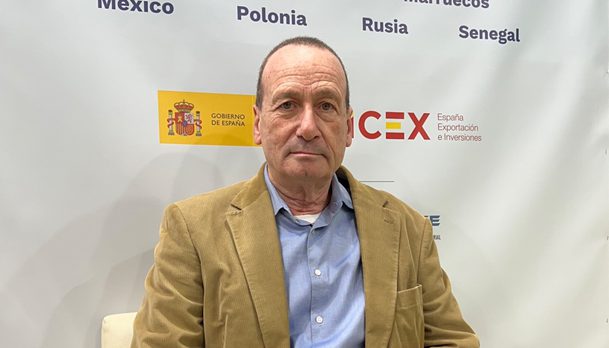
Interview with José Luis Sánchez, head of industrial development at AIDIMME
Information published by Javier García for Interempresas
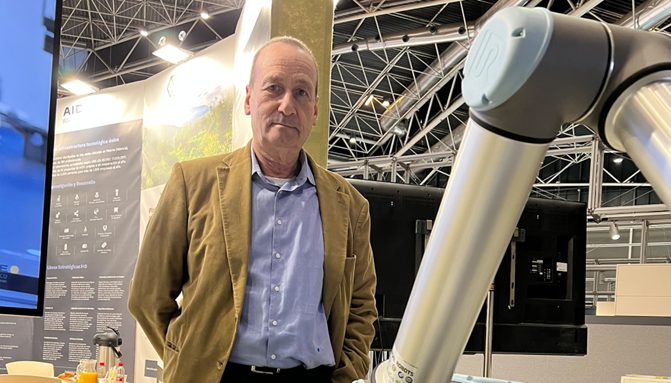
José Luis Sánchez is head of industrial development at AIDIMME, a division that works to improve the manufacturing process efficiency, especially in the wood-furniture and metalworking sectors. In order to do so, the division uses traditional process-improvement tools in a consultancy format (process analysis, lean manufacturing-based techniques, developing improvement methods, customised training, etc.) or technologies focused on digitalisation processes, such as monitoring, automation, robotics, artificial vision, etc. The division is also part of the Plasma project, a demonstrator for 4.0 technologies that captures reliable data within two weeks to start the design of the scanning processes for smart or automated manufacturing. José Luis Sánchez explains what the digitalisation designing entails and how it can help a company, especially a SME.
AIDIMME has initiated the Plasma system. What does it entail?
The Plasma project began in 2018 with the help of IVACE. It focuses on demonstrating the possibilities the digitalisation of these technologies offers in the manufacturing industry, especially in our reference field. Plasma has three demonstrators, two of them are portable and can be moved to the interested companies and the other is installed at AIDIMME – it reproduces a functional manufacturing line for personalised products.
What technologies does it incorporate?
One of the portable demonstrators has a complete process-monitoring system that can extract the information of any manufacturing process and show its operating status – to measure efficiency or analyse any relationship between variables that may interest the company. For example, it can measure product quality and relate it to the relevant variables in the process.
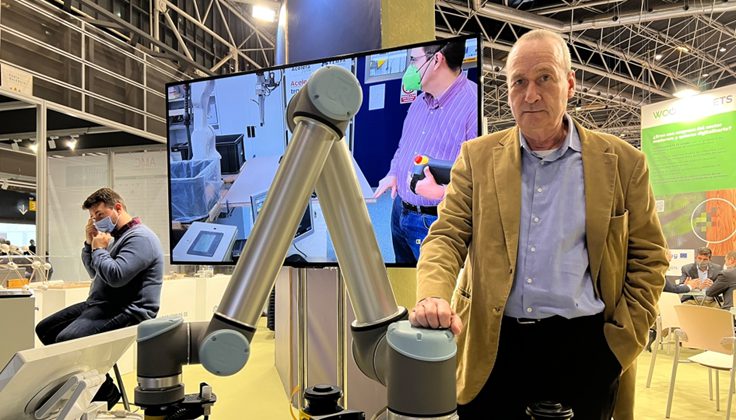
Another demonstrator is a collaborative robot installed over a mobile platform. It can be transferred to a company to evaluate the viability of the automation of any process. For example, it has been used to evaluate automatic machine loading and unloading, sanding and polishing procedures, piece unloading in transport systems, piece assembly, etc. The production line combines multiple technologies.
Which technologies?
RFID identification, collaborative automation focused on assembling parts in cooperation with a person, augmented reality for staff training, machine control integration in the production control system via OPC UA, additive manufacturing for the serial part production…
What type and profile of companies is it aimed at? Who can benefit from the advantages?
Plasma is at the disposal of any company interested in evaluating the integration of these technologies in their processes. There is no company-defined profile for using a demonstrator, though, compared to large companies, normally small and medium-sized enterprises have fewer possibilities to try this type of technology.
Which sectors does it focus on?
Originally it is aimed at the metalworking and wood-furniture sectors, although some technologies can be applied to any manufacturing sector.
There has been talk of mass customisation. What can this platform do to this effect?
As I mentioned, the Plasma production line is designed to manufacture products that are completely personalised, so the implemented technologies are geared in this direction. For example, the fact that each manufactured product is identified individually allows the product itself to communicate directly with each process, automatically indicating the next operation that must take place. This enables the complete automation of the production flow, regardless of the lot size. Each product unit can be different from the previous and the next since the identifier will tell the machine what to do when it has reached a certain procedure.
This entails the machines to be able to adjust automatically and rapidly…
Yes, and by doing so a hundred equal units or a hundred different ones can be manufactured. And if in the assembly process there is a completely flexible machine – like a collaborative robot, a computerised quality-control system based on artificial vision – and is all complemented with an augmented reality system which indicates the specific packaging operation sequence it must carry out for each product. A completely flexible and adequate process is provided for personalised manufacturing or to produce larger or smaller batches (depending on the demand).
It is said that the system allows to evaluate the viability of a digital transformation process and to quantify the investment needed. How does it do it? What aspects does it consider?
Both mobile demonstrators can evaluate the viability of the technologies involved. Because they can be assembled directly into any process, they allow the own company to evaluate the advantages in the monitoring of the processes and the automation of some procedures.
What is this report about?
It analyses the gathered information in monitoring, or the cycle times achieved in the automation. From this data and the estimated investment or expenditures needed to implement the technologies, a payback period can be estimated. Therefore, these companies are provided with valuable information for the decision-making. The tests have not always acquired returns on investment that advise the implementation of one technology or the other.
How is this system being received?
At the beginning many demonstrations took place and the teams were nearly saturated, but now we are available to use the demonstrators in those companies interested in evaluating the digitalisation benefits, with a short waiting time.
Sometimes it seems that in exhibitions and conferences, the solutions for the Industry 4.0 are presented and talked about, though the market is still not assimilating them. In other words, the supply and the demand are moving in different directions, and automation suppliers develop products and solutions that are not yet a reality in companies and production facilities in our country. How aware do you think the industrial sector is – especially the SME – about the new technologies?
I believe the industry is aware of the importance in digitalisation and knows many of the technologies that are currently available and which they can benefit from. But the solution developers’ pace and the industry’s pace are very different, due to the nature of each activity.
In the technological world, anyone who does not bring out an innovation every few months seems to be left behind. But the industry cannot modify constantly its methods, technologies or processes, because the clients demand stability and continuity. The changes must be carefully made and must not disrupt the essence of the business.
This does not mean that the industry cannot integrate the advances that are taking place in each field, but the path must be explored step by step, knowing the strategic priorities. I think this is still one of the main problems, because there are still many companies that do not question their priorities, even if we witness the constant change our surrounding is experiencing.
What arguments would you use to convince the industry about the advantages of the Plasma system?
The best way of convincing is by demonstrating in a practical way that a proposal – or in this case a technology – can work. On this basis, I invite them to experiment and, in view of the results, reach their own decision.
Access the Interempresas interview through this link.
Views: [wpstatistics stat=pagevisits time=total id=30574]
Espacio Industria 4.0 de AIDIMME en Feria FIMMA + MADERALIA
Durante la celebración de la feria FIMMA + MADERALIA, del 29 de marzo al 1 de abril, puede visitar el Espacio Industria 4.0 relacionado con el lijado de piezas y tareas de picking, aplicaciones que AIDIMME ha comenzado a desarrollar.
Expertos de AIDIMME mostrarán cómo se puede supervisar cualquier proceso de fabricación con la ayuda de una sencilla aplicación software que permite medir diversos parámetros del proceso.
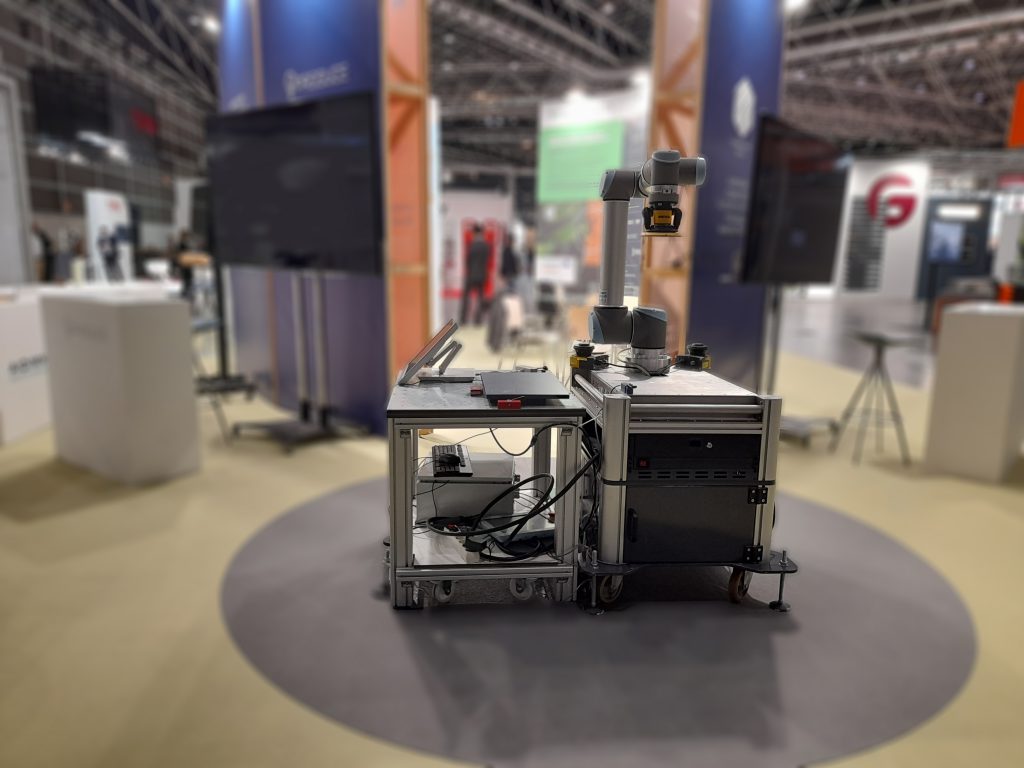
Hoy en día es común el uso de robots en la industria manufacturera, especialmente para realizar tareas repetitivas y en producciones elevadas. También se ha incrementado el uso de sensores externos para adquirir información adicional del entorno de trabajo. En particular, las cámaras y los sistemas de visión artificial brindan flexibilidad y aumentan la precisión de las tareas realizadas por los sistemas robóticos.
Uno de los mayores problemas de la industria es la programación de robots para la ejecución de tareas en entornos altamente cambiantes, bien sea porque cambia el producto (modelo) fabricado debido a la alta rotación requerida por el mercado, bien sea porque cambia el entorno productivo debido a la reconfiguración requerida por el proceso, o bien por otras circunstancias no previstas. Los métodos de programación tradicional, entre otros problemas, requieren un amplio conocimiento técnico por parte del personal responsable y consumen un tiempo considerable.
De ahí surge la necesidad de facilitar el proceso de programación de operaciones industriales en robots, campo en el que AIDIMME está trabajando desde hace varios años.
La industria 4.0 es una de las 9 líneas de I+D del Instituto. Desde el siguiente enlace podrá acceder a información ampliada.
INTERBOT – DESARROLLO DE UNA INTERFAZ HMI PARA LA PROGRAMACIÓN DE ROBOTS MEDIANTE COMANDOS VERBALES Y VISIÓN ARTIFICIAL | Número de proyecto: 22100060 Expediente: IMDEEA/2021/17 Duración: Del 01/07/2021 al 30/06/2022 Coordinado en AIDIMME por: SÁNCHEZ ASINS,JOSÉ LUIS Línea de I+D: INDUSTRIA 4.0 |
PLASMA – DESARROLLO DE PLATAFORMAS DEMOSTRADORAS DE TECNOLOGÍAS PARA LA FÁBRICA INTELIGENTE | Número de proyecto: 21800044 Expediente: IMDE40/2018/4 Duración: Del 01/07/2018 al 31/03/2020 Coordinado en AIDIMME por: SÁNCHEZ ASINS,JOSÉ LUIS Línea de I+D: INDUSTRIA 4.0 |
GVA I4.0 – AUTOPREDICTIVA – AUTOMATIZACIÓN DE PROCESOS MEDIANTE TECNOLOGÍAS DE ANÁLISIS, PREDICCIÓN E INTEGRACIÓN DE APLICACIONES Y SISTEMAS | Número de proyecto: 22000005 Expediente: IMAMCC/2020/1 Duración: Del 01/01/2020 al 31/12/2020 Coordinado en AIDIMME por: SÁNCHEZ ASINS,JOSÉ LUIS Línea de I+D: INDUSTRIA 4.0 |
Para más información contacte con AIDIMME.
Visitas: [wpstatistics stat=pagevisits time=total id=27830]
AIDIMME takes part in the I-ESA 2022
- Last 23rd and 25th of March, the 11th edition of the IESA international conference was held in Valencia.
- In this congress about interoperability in business systems and applications, the AIDIMME technicians presented the different activities the institute carries out.
A practical experience of AI Solution used to improve varnishing-process efficiency in furniture manufacturing
AIDIMME’s Technology and Processes technician Juan Del Agua presented the article ‘A practical experience of AI Solution used to improve varnishing process efficiency in furniture manufacturing’ framed in the workshop ‘Artificial Intelligence beyond Efficiency’.
The presentation exhibited the results of a research where a predictive model to estimate the amount of deposited varnish (grams per square metre) in a flat board was developed.
To conduct this research, an experiment with a roller-coating machine available at AIDIMME’s pilot facility was carried out. With the gathered information of the sensors in different parts of the machine, artificial intelligence techniques were applied to obtain the mentioned predictive model.
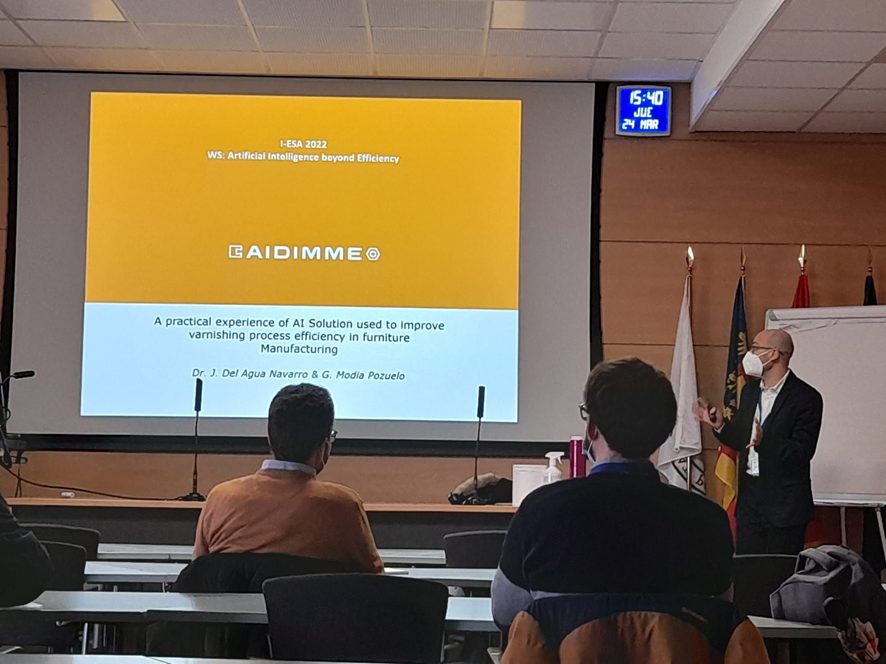
The attendees appreciated obtaining a highly accurate model in a research that applied to a real process.
Experts from the artificial intelligence field recognised that one of the main problems to initiate these solutions in industrial environments is the machine sensorisation required to capture data and carry out model training.
Given the experience in this field, AIDIMME explained that the key is to have from the beginning of the project the production and maintenance staff, to help identify if the external sensor installation will influence the machine’s daily operations. With the agreement and commitment of all the parts, many of the problems derived from this stage can be solved.
During the congress, many research initiatives and results with similar objectives were presented, focusing on the development of predictive systems such as the delivery period in the manufacturing process.
AIDIMME is a specialist in the Industry 4.0 since it is part of the nine points in the Institute’s research and development projects.
Mobile robotics experimentation in industrial environment
Fernando Gigante, Technologies and Processes technician at AIDIMME, presented the article ‘Mobile robotics experimentation in industrial environment’ drafted by AIDIMME and ITC.
It featured a small description of the conditions that the solutions in mobile robotics in industrial environments must accomplish, which are included in the scope of the LOGIBLOCK – Modular platform for the management and display of autonomous vehicle fleet and logistics robots in SME project.
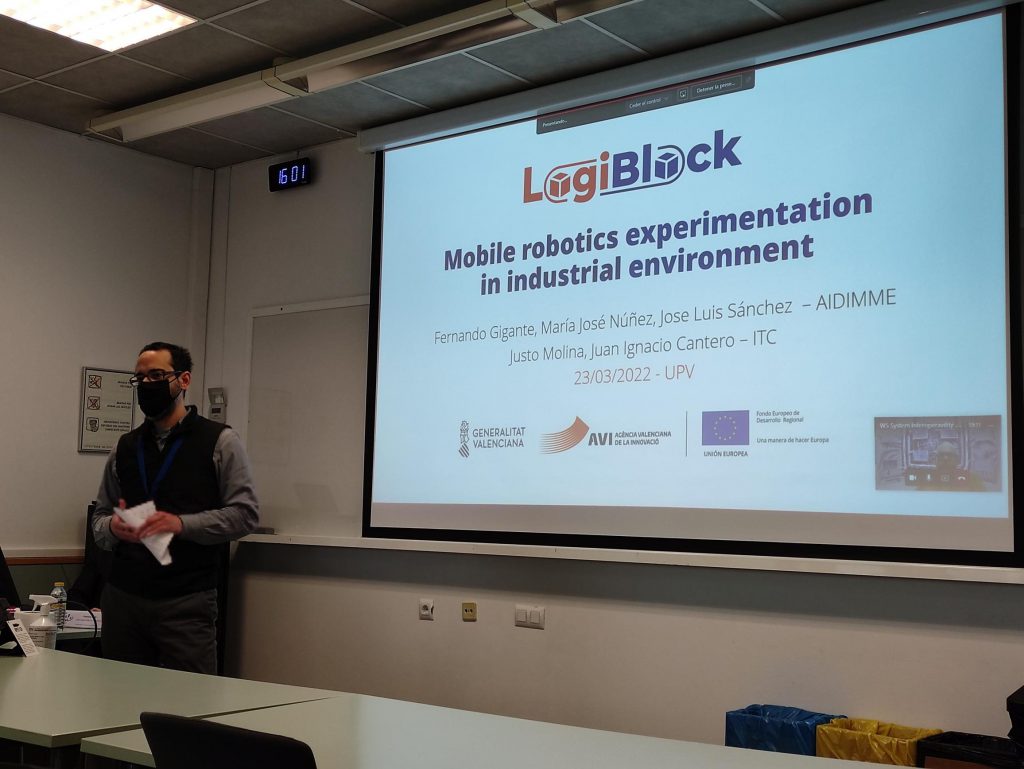
To this effect, the characteristics of the Industry 4.0 were displayed, including the need to create secure collaborative environments where workers and devices can operate in order to improve resource management and productivity.
It described the characteristics of the main types of mobile robots currently used in the industry and the methodology used to carry out the research: identifying key actors, developing a survey for the manufacturers, defining the requirements that a solution of this type must meet, and detecting key indicators to evaluate the impact of implementing these solutions.
Subsequently, a testing scenario of industrial mobile robotics systems based in the robotics laboratory at AIDIMME was introduced, along with a usage case in the ceramics sector.
Lastly, it presented the main obstacles found in enterprises when they adopt these solutions and the main aspects they should include, such as the future actions they must conduct related to this research.

Application of a Visual and Data Analytics Platform for Industry 4.0 enabled by the Interoperable Data Spine: A Real-world Paradigm for Anomaly Detection in the Furniture Domain
This name belongs to the article presented by Fernando Gigante from AIDIMME, describing the initial findings of his work in advanced analysis functions using interoperability provided by EFPF Data Spine.
The article is part of the EFPF project which conducts a federated smart manufacturing factory ecosystem by mainly interconnecting four smart factory platforms from the FoF-11-2016 group through an open and interoperable Data Spine.
The name belongs to the article presented by Fernando Gigante from AIDIMME and drawn up by CERTH, FRAUNHOFER FIT and AIDIMME associates.
It presents a paradigm about the detection of anomalies in the furniture industry – which also applies to other sectors – demonstrating the implementation of an analytics tool via the Data Spine (DS) component that provides interoperability between services.
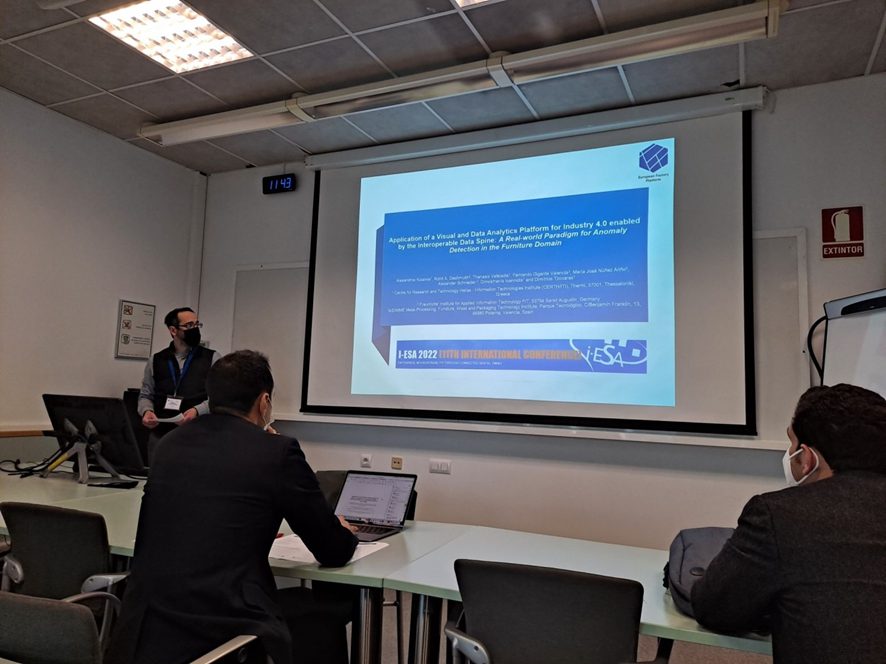
This component was developed in the context of the EFPF (European Connected Factory Platform for Agile Manufacturing) European project.
After an overall perspective of the topics to be discussed, the current problem related to operability between different systems is described, as well as how DS allows this communication between services on different platforms – such as via the transformation of data models.
The component’s architecture is explained in more detail, depicting a data flow that illustrates its implementation in a real environment.
Some details about the analytic tool used (Visual and Data Analytics Tool) are also described, as well as its deployment from the user’s perspective and the algorithms involved in the data analysis machine.
The use case is represented by the children’s furniture manufacturing company LAGRAMA.
Finally, the obtained conclusions from the research are described.


I-ESA Interoperability for enterprise systems and applications
The international conference, which has been going on for 11 editions, chose Valencia to be the host of the 2022 conference – as happened in 2012.
The I-ESA 2022 Conference is organized by the Universitat Politècnica de València on behalf of INTERVAL (Spanish centre of INTEROP-Vlab) and the Virtual Laboratory for Enterprise Interoperability, sponsored by the International Federation for Information Processing and the International Federation of Automatic Control.
The event offers the opportunity to exchange experiences in enterprise interoperability.


For further information contact AIDIMME.
Views: [wpstatistics stat=pagevisits time=total id=30568]
AIDIMME participa en la I-ESA 2022

- Los pasados días 23 a 25 de marzo tuvo lugar la 11ª edición del congreso internacional IESA celebrada en Valencia.
- En el congreso que trata sobre la interoperabilidad para sistemas y aplicaciones empresariales, técnicos de AIDIMME participaron exponiendo presentaciones relacionadas con las actividades del Insituto.
A practical experience of AI Solution used to improve varnishing process efficiency in furniture manufacturing
El técnico de Tecnologías y procesos de AIDIMME, Juan Del Agua, expuso el artículo “A practical experience of AI Solution used to improve varnishing process efficiency in furniture manufacturing”, enmarcado dentro del workshop “Artificial Intelligence beyond Efficiency”.
En dicha presentación se mostró el resultado de una investigación donde se ha desarrollado un modelo predictivo para estimar la cantidad de barniz depositado (gramos por metro cuadrado) en una pieza de tablero plana.
Para llevar a cabo la investigación, se realizó una experimentación con una barnizadora de rodillos disponible en la planta piloto de AIDIMME. Con la información acumulada de sensores en diferentes puntos de la máquina, se aplicaron técnicas de inteligencia artificial para obtener el mencionado modelo predictivo.
Los asistentes a la jornada valoraron muy positivamente haber obtenido un modelo de gran precisión en una investigación aplicada a un proceso real.
Expertos en el campo de la inteligencia artificial identificaron como una de las barreras para la puesta en marcha en entornos industriales de este tipo de soluciones, la sensorización de maquinaria requerida para capturar datos y poder realizar el entrenamiento de los modelos.
Desde la experiencia de AIDIMME en éste ámbito, se indicó que la clave es contar desde el inicio del proyecto tanto con el personal de producción como de mantenimiento, y así identificar si la instalación de sensores externos va a incidir en la operativa diaria con la máquina en cuestión. Con el consenso e implicación de todos estos actores, pueden solventarse gran parte de los problemas derivados de ésta etapa.
Durante el congreso se expusieron iniciativas y resultados de investigación con objetivos similares, enfocados en el desarrollo de sistemas predictivos, como por ejemplo, del plazo de entrega en procesos de fabricación.
AIDIMME es experto en industria 4.0, siendo ésta una de las 9 líneas de I+D del Instituto.
Mobile robotics experimentation in industrial environment
Por otra parte, Fernando Gigante, técnico de Tecnologías y procesos de AIDIMME presentó el artículo “Mobile robotics experimentation in industrial environment”, elaborado entre los centros AIDIMME e ITC.
Éste presenta una breve descripción de las condiciones que deberían cumplir las soluciones de robótica móvil en entornos industriales, todo ello en el ámbito del proyecto LOGIBLOCK – Plataforma modular para el despliegue y gestión de flotas de vehículos autónomos y robots logísticos en pymes.
Para ello se muestran las características de la Industria 4.0, entre las que se incluye la necesidad de crear entornos colaborativos seguros donde operen trabajadores y dispositivos, lo cual permite mejorar la gestión de recursos y la productividad.
Se describen las características de los principales tipos de robots móviles utilizados actualmente en la industria, y la metodología utilizada para realizar el estudio, la cual consiste en la identificación de los actores clave, la elaboración de una encuesta dirigida a fabricantes, la definición de requerimientos que debe cumplir una solución de este tipo, y la detección de indicadores clave para evaluar el impacto de la adopción de estas soluciones.
Posteriormente, se introduce un escenario de experimentación de sistemas de robótica móvil industrial basado en el laboratorio de robótica de AIDIMME, además de un caso de uso focalizado en el sector de la cerámica.
Finalmente, se presentan las principales barreras que encuentran las empresas a la hora de adoptar estas soluciones, y las características más relevantes que éstas deben tener, así como aquellas acciones futuras a realizar relacionadas con este estudio.
Application of a Visual and Data Analytics Platform for Industry 4.0 enabled by the Interoperable Data Spine: A Real-world Paradigm for Anomaly Detection in the Furniture Domain
Este es el nombre del artículo también presentado por Fernando Gigante, de AIDIMME. En él describe los hallazgos iniciales de su trabajo en funciones avanzadas de análisis de datos utilizando la interoperabilidad proporcionada por EFPF Data Spine.
El artículo pertenece al proyecto EFPF, el cual realiza un ecosistema de fábrica inteligente federado al interconectar principalmente 4 plataformas de fábrica inteligente, del grupo FoF-11-2016, a través de un Data Spine abierto e interoperable.
Este es el nombre del artículo presentado por Fernando Gigante, de AIDIMME, y elaborado por los socios CERTH, FRAUNHOFER FIT y AIDIMME.
En él, se presenta un paradigma sobre la detección de anomalías en el sector del mueble, aplicable a otros sectores, demostrando la aplicación de una herramienta de analítica de datos a través del componente Data Spine (DS) que proporciona la interoperabilidad entre servicios.
Dicho componente, se ha desarrollado en el contexto del proyecto europeo EFPF (European Connected Factory Platform for Agile Manufacturing).
Tras una visión general de los temas a abordar, se describe la problemática actual relacionada con la interoperabilidad entre diferentes sistemas y cómo la DS permite dicha comunicación entre servicios de distintas plataformas, entre otros mediante la transformación de modelos de datos.
La arquitectura del componente es explicada en más detalle, representando un flujo de información que ejemplifica su aplicación en un entorno real.
También se describen brevemente algunos detalles de la herramienta de analítica utilizada (Visual and Data Analytics Tool), su utilización desde el punto de vista de usuario, y los algoritmos involucrados en el análisis de datos de máquina.
El caso de uso se representa a través de la empresa fabricante de mobiliario juvenil LAGRAMA.
Finalmente, se describen las conclusiones obtenidas a partir de dicha investigación.
I-ESA Interoperability for enterprise systems and applications
La conferencia internacional que acumula 11 ediciones ha elegido la ciudad de Valencia para celebrar su última edición, al igual que ocurrió en el año 2012.
La Conferencia I-ESA 2022 está organizada por la Universidad Politécnica de Valencia en representación de INTERVAL (Polo Español de INTEROP-Vlab) y el Laboratorio Virtual de Interoperabilidad Empresarial, patrocinado por la Federación Internacional para el Proceso de la Información y la Federación Internacional de Control Automático.
El encuentro es considerado una oportunidad de intercambio de experiencias sobre la interoperabilidad empresarial.
Para más información contacte con AIDIMME.
Visitas: [wpstatistics stat=pagevisits time=total id=27805]
AIDIMME takes part in the I-ESA 2022
- Last 23rd and 25th of March, the 11th edition of the IESA international conference was held in Valencia.
- In this congress about interoperability in business systems and applications, the AIDIMME technicians presented the different activities the institute carries out.
A practical experience of AI Solution used to improve varnishing-process efficiency in furniture manufacturing
AIDIMME’s Technology and Processes technician Juan Del Agua presented the article ‘A practical experience of AI Solution used to improve varnishing process efficiency in furniture manufacturing’ framed in the workshop ‘Artificial Intelligence beyond Efficiency’.
The presentation exhibited the results of a research where a predictive model to estimate the amount of deposited varnish (grams per square metre) in a flat board was developed.
To conduct this research, an experiment with a roller-coating machine available at AIDIMME’s pilot facility was carried out. With the gathered information of the sensors in different parts of the machine, artificial intelligence techniques were applied to obtain the mentioned predictive model.
The attendees appreciated obtaining a highly accurate model in a research that applied to a real process.
Experts from the artificial intelligence field recognised that one of the main problems to initiate these solutions in industrial environments is the machine sensorisation required to capture data and carry out model training.
Given the experience in this field, AIDIMME explained that the key is to have from the beginning of the project the production and maintenance staff, to help identify if the external sensor installation will influence the machine’s daily operations. With the agreement and commitment of all the parts, many of the problems derived from this stage can be solved.
During the congress, many research initiatives and results with similar objectives were presented, focusing on the development of predictive systems such as the delivery period in the manufacturing process.
AIDIMME is a specialist in the Industry 4.0 since it is part of the nine points in the Institute’s research and development projects.
Mobile robotics experimentation in industrial environment
Fernando Gigante, Technologies and Processes technician at AIDIMME, presented the article ‘Mobile robotics experimentation in industrial environment’ drafted by AIDIMME and ITC.
It featured a small description of the conditions that the solutions in mobile robotics in industrial environments must accomplish, which are included in the scope of the LOGIBLOCK – Modular platform for the management and display of autonomous vehicle fleet and logistics robots in SME project.
To this effect, the characteristics of the Industry 4.0 were displayed, including the need to create secure collaborative environments where workers and devices can operate in order to improve resource management and productivity.
It described the characteristics of the main types of mobile robots currently used in the industry and the methodology used to carry out the research: identifying key actors, developing a survey for the manufacturers, defining the requirements that a solution of this type must meet, and detecting key indicators to evaluate the impact of implementing these solutions.
Subsequently, a testing scenario of industrial mobile robotics systems based in the robotics laboratory at AIDIMME was introduced, along with a usage case in the ceramics sector.
Lastly, it presented the main obstacles found in enterprises when they adopt these solutions and the main aspects they should include, such as the future actions they must conduct related to this research.
Application of a Visual and Data Analytics Platform for Industry 4.0 enabled by the Interoperable Data Spine: A Real-world Paradigm for Anomaly Detection in the Furniture Domain
This name belongs to the article presented by Fernando Gigante from AIDIMME, describing the initial findings of his work in advanced analysis functions using interoperability provided by EFPF Data Spine.
The article is part of the EFPF project which conducts a federated smart manufacturing factory ecosystem by mainly interconnecting four smart factory platforms from the FoF-11-2016 group through an open and interoperable Data Spine.
The name belongs to the article presented by Fernando Gigante from AIDIMME and drawn up by CERTH, FRAUNHOFER FIT and AIDIMME associates.
It presents a paradigm about the detection of anomalies in the furniture industry – which also applies to other sectors – demonstrating the implementation of an analytics tool via the Data Spine (DS) component that provides interoperability between services.
This component was developed in the context of the EFPF (European Connected Factory Platform for Agile Manufacturing) European project.
After an overall perspective of the topics to be discussed, the current problem related to operability between different systems is described, as well as how DS allows this communication between services on different platforms – such as via the transformation of data models.
The component’s architecture is explained in more detail, depicting a data flow that illustrates its implementation in a real environment.
Some details about the analytic tool used (Visual and Data Analytics Tool) are also described, as well as its deployment from the user’s perspective and the algorithms involved in the data analysis machine.
The use case is represented by the children’s furniture manufacturing company LAGRAMA.
Finally, the obtained conclusions from the research are described.
I-ESA Interoperability for enterprise systems and applications
The international conference, which has been going on for 11 editions, chose Valencia to be the host of the 2022 conference – as happened in 2012.
The I-ESA 2022 Conference is organized by the Universitat Politècnica de València on behalf of INTERVAL (Spanish centre of INTEROP-Vlab) and the Virtual Laboratory for Enterprise Interoperability, sponsored by the International Federation for Information Processing and the International Federation of Automatic Control.
The event offers the opportunity to exchange experiences in enterprise interoperability.
For further information contact AIDIMME.
Views: [wpstatistics stat=pagevisits time=total id=27805]
La macroplataforma europea EFPF expondrá su propuesta de Industria 4.0 en FIMMA-Maderalia 2022 en Feria Valencia
La iniciativa “European connected Factory PlatForm for agile manufacturing”, EFPF, estará presente en el certamen FIMMA-Maderalia que se desarrolla en Feria Valencia entre el 29 de marzo y el 1 de abril próximos, en el pabellón 1 del nivel 3, estand B11.
Este macroproyecto europeo impulsa la integración de la industria europea en las tecnologías 4.0, con la participación de 30 entidades de 11 países europeos bajo la coordinación del Instituto Tecnológico AIDIMME.
La iniciativa pretende que las empresas manufactureras puedan colaborar en procesos de diseño, ingeniería y fabricación, de forma colaborativa, consiguiendo llegar a la Smart Factory, o fábrica inteligente, y siguiendo protocolos de seguridad de datos entre empresas.
En concreto, la plataforma EFPF ofrece acceso unificado a una gran cantidad de herramientas y servicios interoperables que incluyen, entre otros, soluciones digitales para conectividad de fábrica, diseño y ejecución de flujo de trabajo distribuido, planificación de producción distribuida, monitoreo y alerta de planta, gemelos digitales, gestión de riesgos y análisis de datos.
De esta forma, la Plataforma aporta múltiples soluciones de fabricación digital, herramientas inteligentes de producción, e implementaciones de la Industria 4.0, como análisis predictivos, conectividad de dispositivos en planta (PLC’s), análisis de riesgos y forecasting, y otras como gestión de catálogos, control de contenedores de residuos, o licitaciones y ofertas para las necesidades de los asociados.
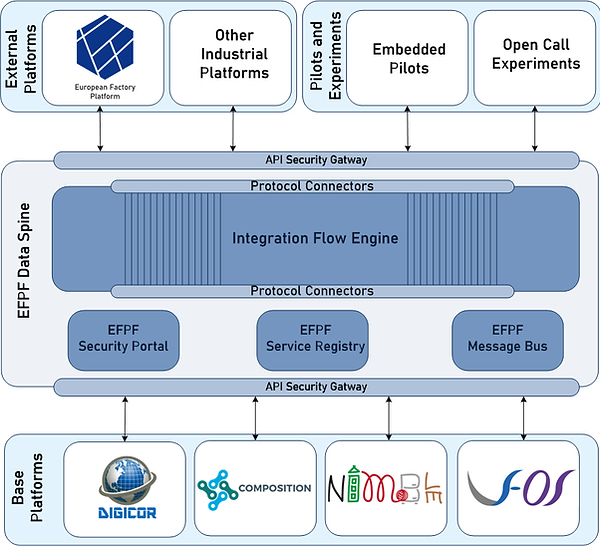
Por otro lado, la adopción de protocolos de seguridad y estándares de interoperabilidad comunes permiten interacciones fluidas e intercambio de datos entre múltiples herramientas y servicios, al tiempo que preserva las preocupaciones de seguridad y privacidad.
El Instituto Tecnológico AIDIMME se implica así en seguir trabajando en plataformas colaborativas para que las empresas manufactureras puedan colaborar y ser más competitivas.
“European connected Factory PlatForm for agile manufacturing”, EFPF, es un proyecto del programa Horizonte 2020 de investigación e innovación de la Unión Europea bajo el acuerdo de subvención n.º 825075, con un presupuesto de 16.368.842 euros y una financiación de 13.640.264 euros, que termina a finales de este año 2022.
European connected Factory PlatForm for agile manufacturing – EFPF
Número de proyecto: 21800046
Expediente: 825075
Duración: Del 01/01/2019 al 31/12/2022
Coordinado en AIDIMME por: NÚÑEZ ARIÑO, Mª JOSÉ
Línea de I+D: INDUSTRIA 4.0

Para más información, contacte con AIDIMME.
[wpstatistics stat=pagevisits time=total id=27657] visitas
B2B Meetings «WOODMARKETS» en FIMMA-Maderalia 2022
El proyecto WOODMARKETS “La transformación digital al servicio de la industria de la madera del espacio SUDOE” le invita a los B2B Meetings «WOODMARKETS» (encuentros profesionales) que tendrán lugar en el espacio B11 del Nivel 3 Pabellón 1, compartido junto a COFEARFE-ARVET y AIDIMME, en la 39ª edición de la Feria Internacional de Tecnología, Materiales y Componentes para el Mueble, Interiorismo y Proyectos Contract, en Feria Valencia del 29 de marzo al 1 de abril.
¿En que consiste WOODMARKETS?
WOODMARKETS es un proyecto que contribuye al fomento de la competitividad de las empresas de transformación de la madera en toda su cadena de valor. La transformación digital en el sector maderero ha empezado tímidamente y las empresas ven en ella una oportunidad para incrementar ventas y posicionarse en un mercado global. El objetivo de WOODMARKETS es promover la introducción de la digitalización en la industria maderera del espacio SUDOE, contribuyendo a mejorar las competencias, la visibilidad y la competitividad del sector, apoyándola en información, formación y herramientas y servicios de desarrollo digital. WOODMARKETS se adaptará a las necesidades, prioridades y a los niveles de evolución digital de cada eslabón industrial (primera, segunda y tercera transformación). Un servicio transnacional de apoyo a la transformación digital será el producto principal. El proyecto además ayuda a las empresas a definir una Estrategia y un Plan de acción de integración digital y mejora las capacidades y las competencias de las pymes y sus entidades sectoriales para acelerar la transición digital en el espacio SUDOE maderero.
¿Cuáles son sus OBJETIVOS?
El objetivo principal del proyecto es apoyar la introducción y reforzar el entorno digital de las empresas de primera, segunda y tercera transformación de la madera a través de grupos de tareas (GT) que dan respuesta a los 3 objetivos planteados:
- Ayudar a las empresas del sector de la madera a definir una estrategia de apoyo a la transición digital.
- Acompañar el desarrollo de herramientas y servicios de innovación digital destinados a las pymes madereras.
- Mejorar las capacidades y las competencias de las pymes y sus entidades sectoriales para acelerar la transición digital.
Acércate por nuestro espacio y te contaremos más detenidamente todo sobre el proyecto WOODMARKETS y como puede ayudar a tu empresa a mejorar su entorno digital para fomentar su competitividad.
WOODMARKETS es un proyecto co-financiado al 75% por el Fondo Europeo de Desarrollo Regional (FEDER) a través del programa Interreg Sudoe. El programa Interreg Sudoe apoya el desarrollo tecnológico y la innovación, la mejora de la competitividad de las PYMEs, el desarrollo sostenible, la prevención y la gestión de riesgos, la protección del medioambiente y el uso racional de los recursos.
Número de proyecto: 21800063
Expediente: SOE3/P2/F0925
Duración: Del 01/10/2019 al 31/03/2023
Coordinado en AIDIMME por: SEGURA ORENGA, GUILLEM
Línea de I+D: INDUSTRIA 4.0
Para más información contacte con AIDIMME.
Visitas: [wpstatistics stat=pagevisits time=total id=27608]
La iniciativa Interbot permitirá a los operarios de línea reconfigurar los cobots mediante órdenes verbales
• AIDIMME desarrolla la iniciativa Interbot para idear un novedoso sistema de programación de robots colaborativos basado en órdenes verbales, denominado “Desarrollo de una interfaz para la programación de robots mediante comandos verbales y visión artificial”.
La narrativa de aventuras y de ciencia-ficción han adelantado numerosos artefactos y dispositivos que se han convertido en realidad al cabo de los años.
Una anticipación que forma parte de la esencia del ser humano por su curiosidad e iniciativa basada en un permanente interés por explorar y descubrir, y ya en el terreno de la opinión se puede añadir el verbo dominar.
Quedémonos con las aportaciones y las investigaciones que han repercutido beneficios para la humanidad, donde sin duda en la cúspide están las réplicas humanas y todos las situaciones o procesos en los que una máquina-humanoide podría sustituir una acción-pensamiento humanos, obviamente en el terreno puro de la ciencia-ficción…, o no.
Robótica colaborativa
Podemos convenir que desde el origen de los primeros brazos robóticos para la cadena de automoción a mitad del siglo XX, hasta los ya reales servicios de hostelería en proceso de pruebas, hay una progresión imparable que va incorporando resultados en los procesos productivos, como los robots colaborativos conocidos como cobots.
En el momento actual, la integración de estos robots colaborativos en líneas de producción industrial requiere de personal experto en programación (ingenieros e informáticos) encargados de generar un programa de robot a medida para cada proceso particular.
Cuando el proceso donde se integra el robot sufre un ligero cambio, por ejemplo en la geometría de la pieza con la que se trabaja o en la posición donde deben colocarse esas piezas, es necesario que los especialistas modifiquen el código de programación.
Voz, orden, código, acción
En este contexto, AIDIMME desarrolla la iniciativa Interbot para idear un novedoso sistema de programación de robots colaborativos basado en órdenes verbales, denominado “Desarrollo de una interfaz para la programación de robots mediante comandos verbales y visión artificial”.
De esta manera, el propio operario puede generar nuevos programas de robot a la carta.
Por tanto, este sistema, una vez haya finalizado la fase de instalación inicial del robot colaborativo, facilita la programación del robot cada vez que se necesite cambiar el programa o generar uno nuevo.
Autonomía 4.0
Esta rápida reconfiguración reduce ostensiblemente los tiempos para adaptarse a nuevas situaciones del proceso, como nuevas operaciones o nuevas piezas, entre otras opciones que sin duda abren una puerta a una dimensión donde el propio individuo decide qué y cuándo programar nuevas funciones robóticas.
El proyecto Interbot, financiado por IVACE con expediente IMDEEA/2021/17, propone así un futuro ya en marcha gracias al desarrollo del Instituto Tecnológico AIDIMME.
En colaboración con Juan del Agua, José Manuel Arencibia, y Carlos Pérez
Número de proyecto: 22100060
Expediente: IMDEEA/2021/17
Duración: Del 01/07/2021 al 30/06/2022
Coordinado en AIDIMME por: SÁNCHEZ ASINS, JOSÉ LUIS
Línea de I+D: INDUSTRIA 4.0

Para más información contacte con AIDIMME.
Visitas: [wpstatistics stat=pagevisits time=total id=27590]
Second mobility of the european project Erasmus+ Smartrain in Italy
The SMARTRAIN project continues with its progress, and this time the second mobility was held in Italy, during the week of March 7 to 11 2021.
Students and teachers of the project, together with technical managers of the project partners, travelled to the headquarters of Enaip Lombardia in Cantu, Lombardy region, in northern Italy. There, a set of activities were carried out with the common link of 3D printing, teamwork and based on the projects that each of the groups are developing, and their usefulness for the wood-furniture sector.
During the mobility, Enaip Lombardia, coordinated by Sara Tettamanti, responsible for the International Area of this entity, organized an attractive schedule for this mobility within the project. Activities ranged from group dynamics/games to promote teamwork, to training activities on 3D, practical activities on 3D modelling on 3D printers and laser cutting equipment, including a series of visits to ENAIP’s FABLAB facilities, to two local companies: TABU and RIVA 1920, and to the Polytechnic University of Milan.
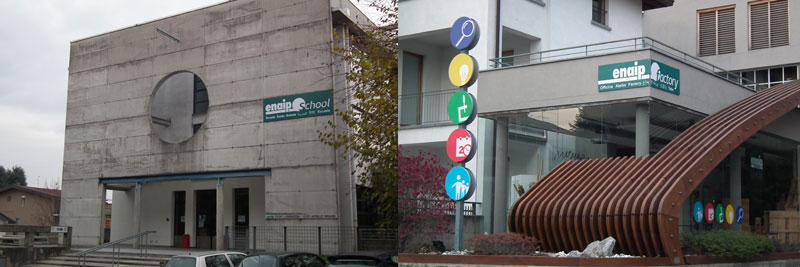
The working sessions were held in ENAIP’s FABLAB, with an initial contact with the areas available to the users of this ENAIP centre.
This space has three different areas:
- An event area to host meetings and workshops on design and wood design;
- A cultural area with 3 important furniture design collections «Neoliberty e Dintorni» and «Mobili come aforismi – 35 mobili del razionalismo italiano» belonging to Federlegno Arredo eventi spa, Collezione «Bruno Munari» belonging to the Municipality of Cantù and the Associazione Amici dei Musei di Cantù. There is also a library with over 3,000 magazines, 2,000 books and publications on wood and wood design area;
- An experimentation area where there is the ToMake FabLab, open to local schools, young students and companies.
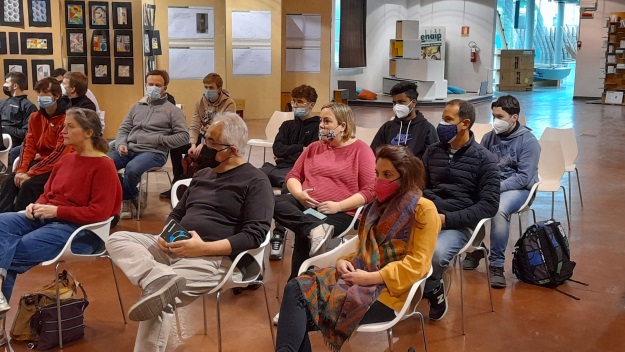
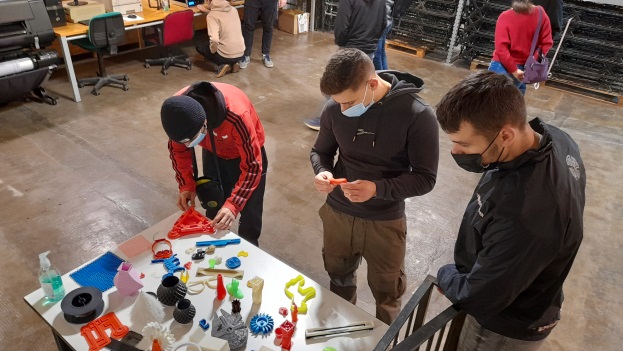
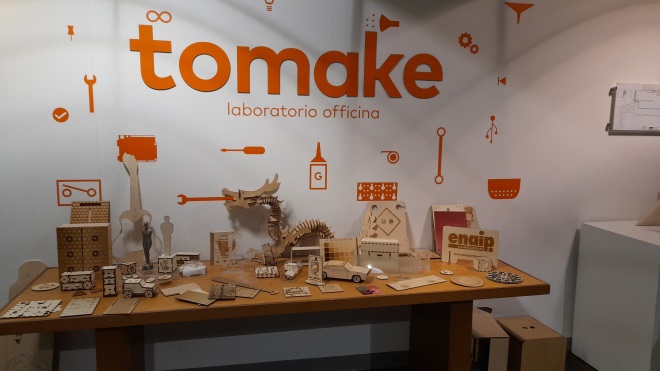
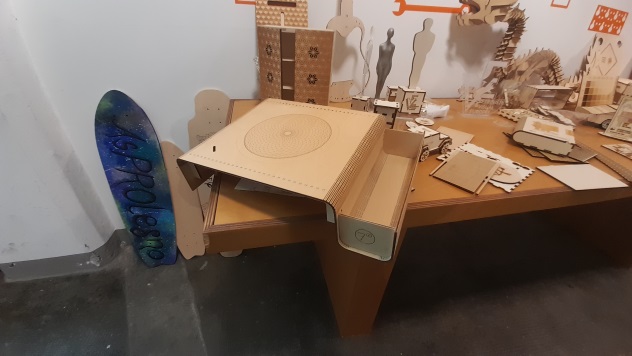
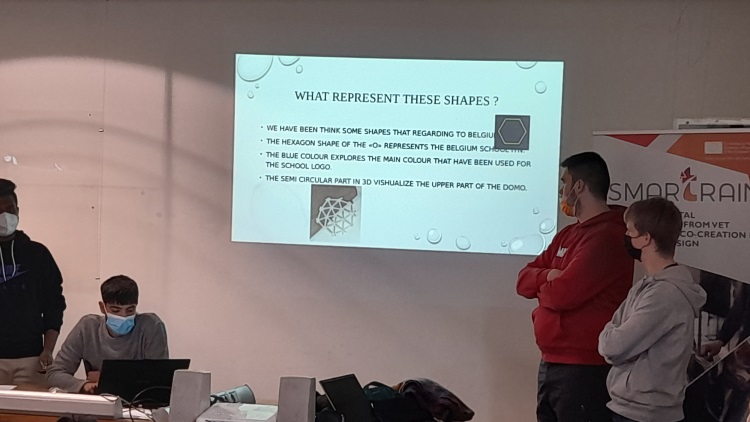
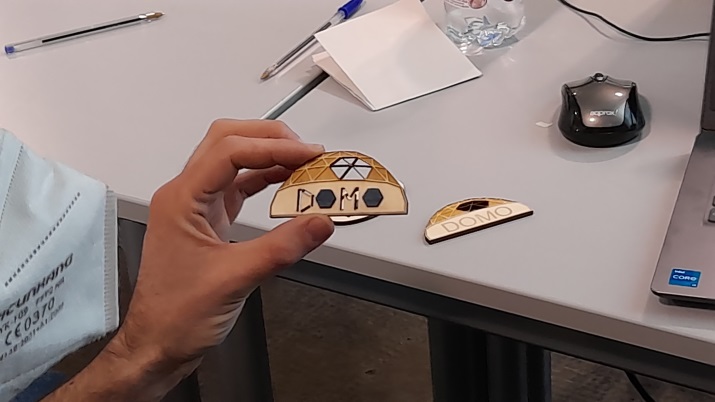
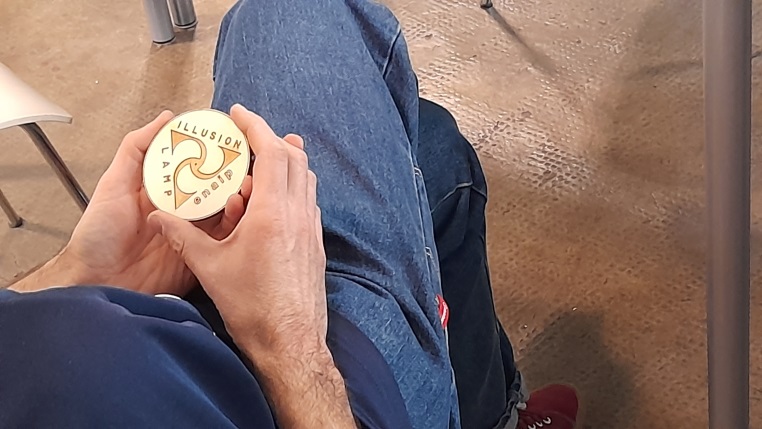
The students participating in the mobility were distributed in mixed groups, with a mix of nationalities in each team. Together with the teachers, they worked with guidelines to start the tasks in which each working group had to name their product and to think, co-create, design and make the logo related to their product, using 3D printing and laser cutting. Beforehand, the participants played a game to break the ice amongthem, in which they were aware of the limitations of language (which are not so much), of the different points of view in different environments, with people who think differently, etc.
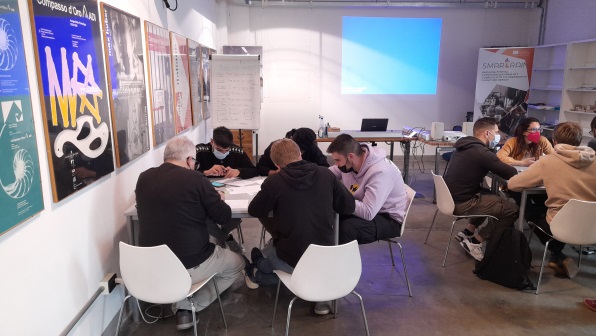
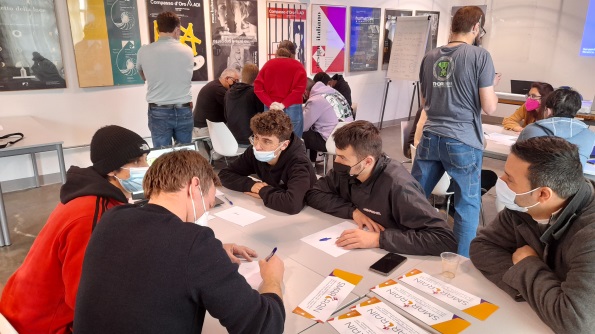
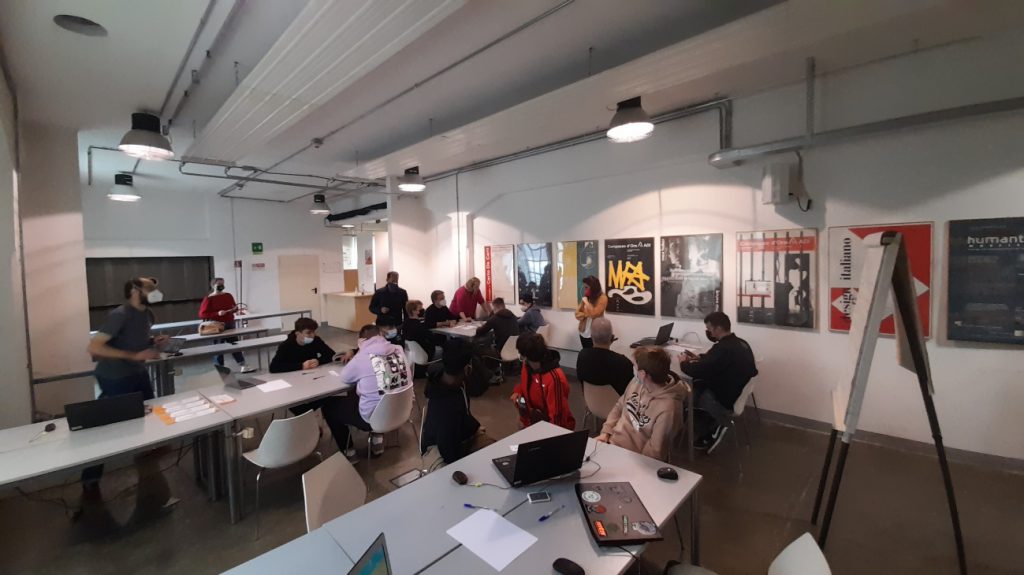
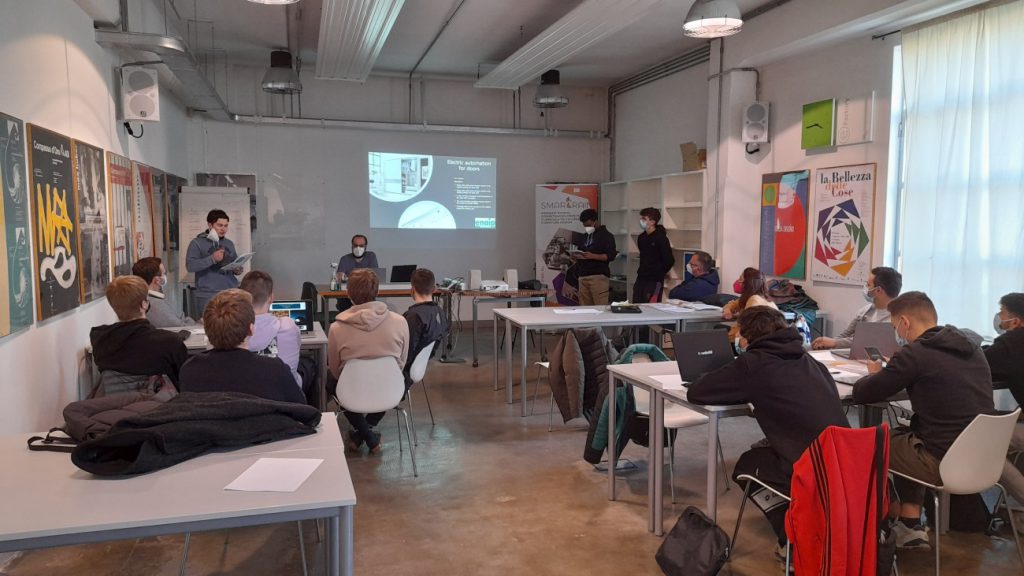
On the other hand, during this day, each of the working groups presented their projects, based on the initial training they had in Belgium, on key concepts of circular economy. The products presented have different characteristics.
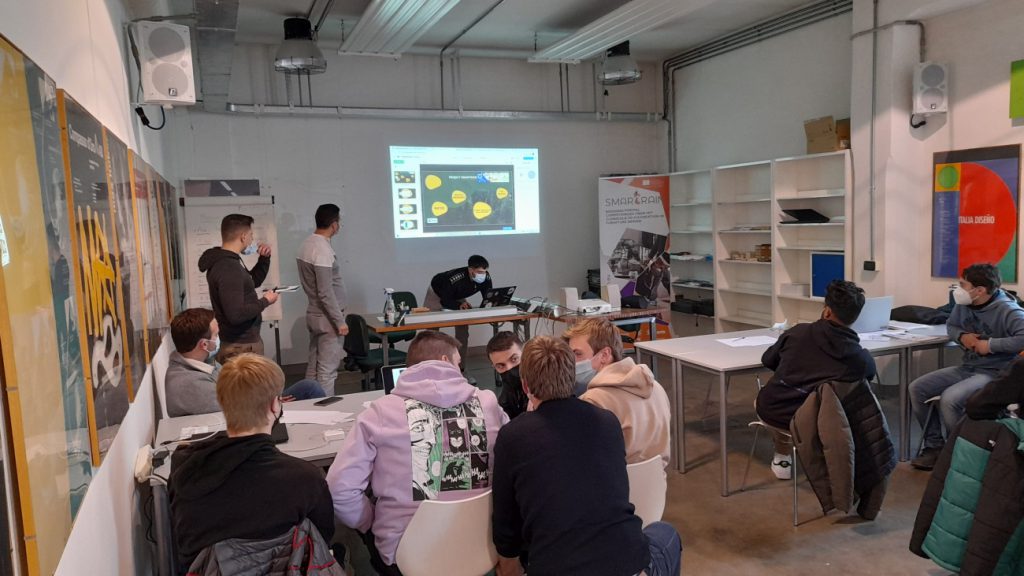
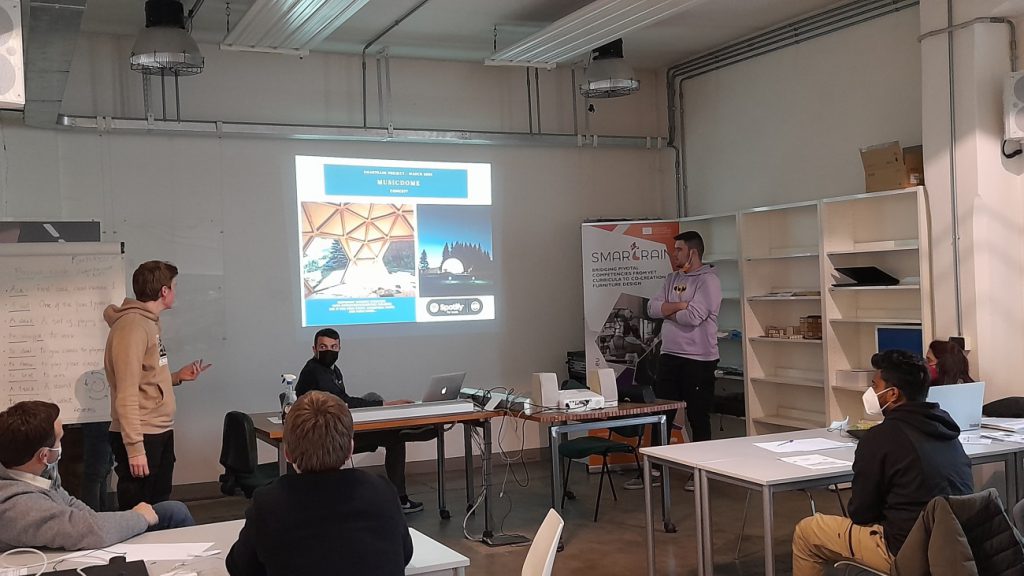
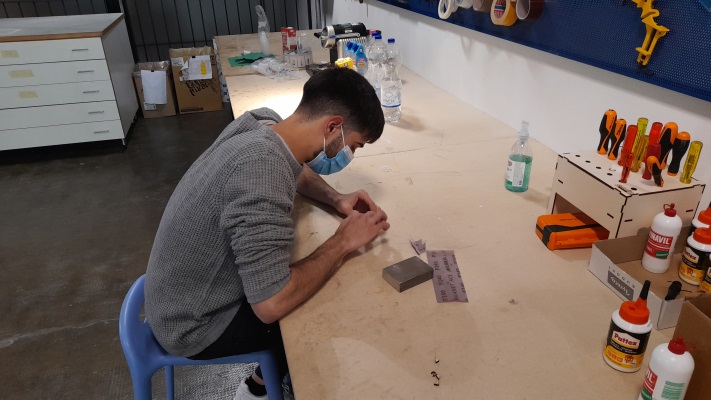
Once the logos were defined, each working team built prototypes with the materials and equipment available at the FAB LAB, experimenting with materials, processing, options, etc.
Visits to companies and institutions
The visits included Enaip’s wood and furniture training workshops, the companies TABU, Riva1920, and the Politecnico di Milano.
Visit to Enaip’s workshop
Enaip’s workshop is equipped with modern machinery for wood and furniture students. It works mainly on interior fittings for buildings:
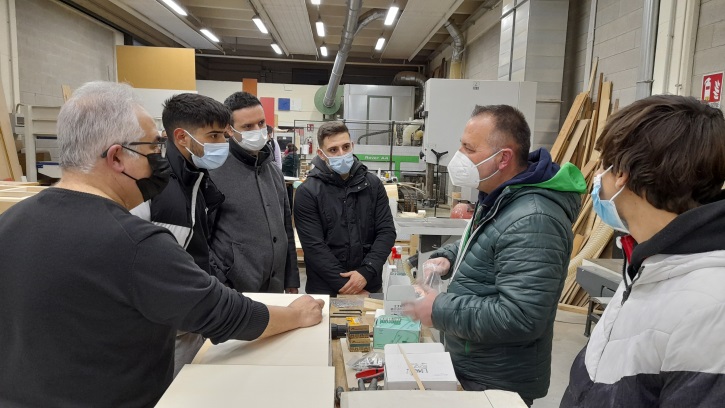
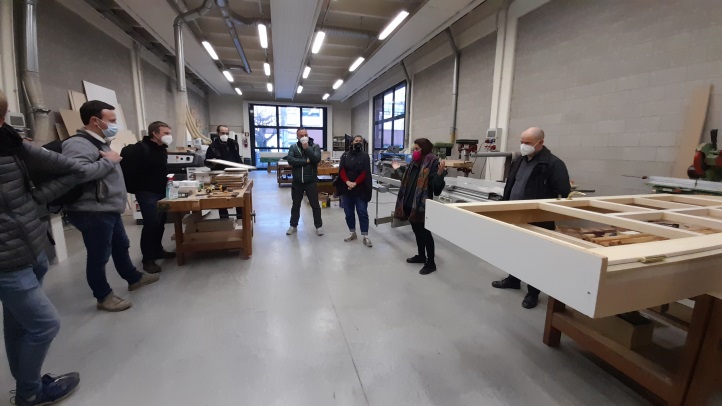
Students and teachers exchanged views on processes, materials and designs they work on at the Centre, etc.
Visit to TABU
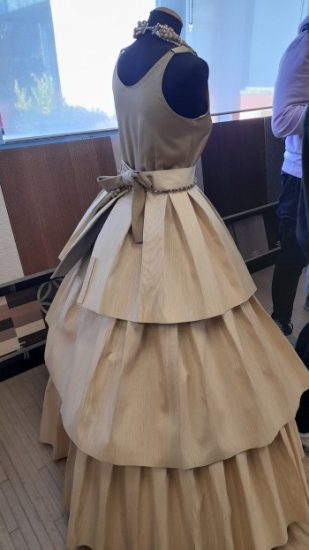
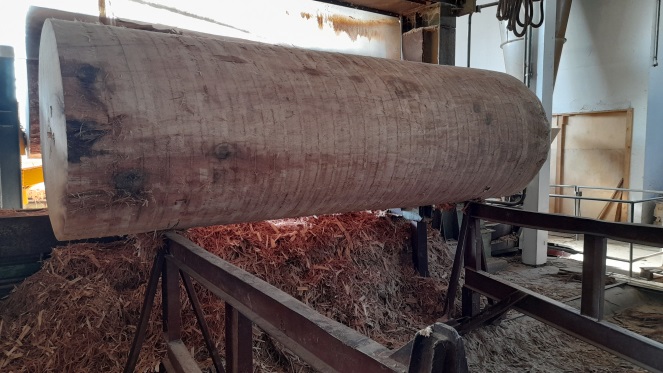
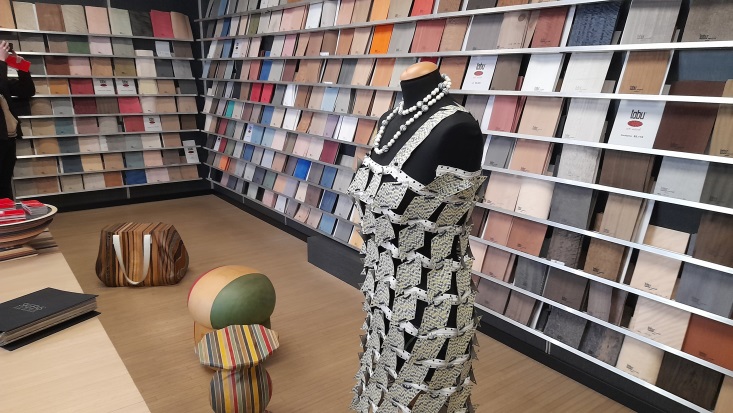
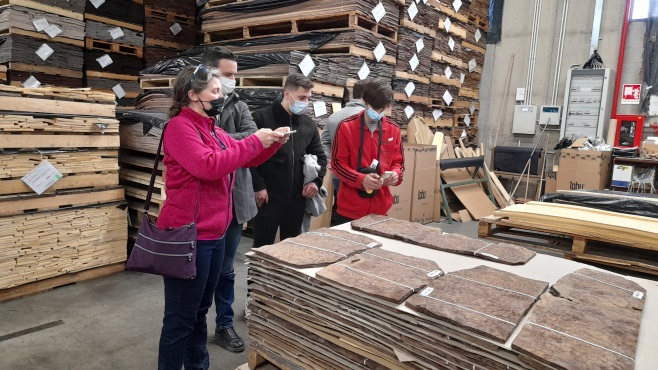
TABU is an acronym of the name of the Tagliabue family, who founded it three generations ago.It is an authentic wood tailoring company that is constantly researching into the processes of dyeing technology applied to dozens of wood species. Its core business is the production of wood veneers and the dyeing process, which guarantees colour homogeneity and infinite replicability: the certainty of colour is fundamental for a customer industry.
Visit to Riva 1920
Founded in Brianza in 1920, Riva 1920 has been producing solid wood furniture of all kinds for over a hundred years. It produces everything from tables, to chairs, to bookcases, to entire kitchens: everything is made by specialized professional craftsmen, who create true works of art in wood. Riva is one of the companies that contributes most to reinforcing the perception of «Made in Italy» worldwide.
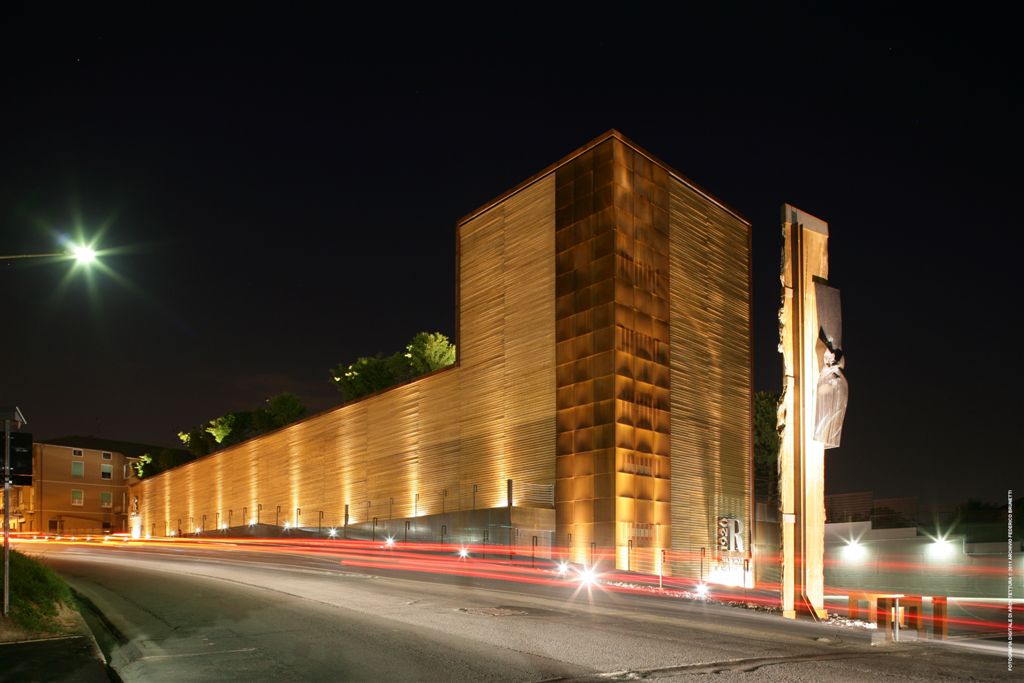
As indicated on its website, the RIVA CENTER is a striking building clad entirely in Siberian larch wood, which opened in 2010.
The cladding is the result of a design idea of Renzo Piano’s Building Workshop d carried out by Harvard University. Inside the building, you can visit a museum with lots of tools and tools for woodworking, a showroom and the PANGEA LAB with a very complete xylotheque.
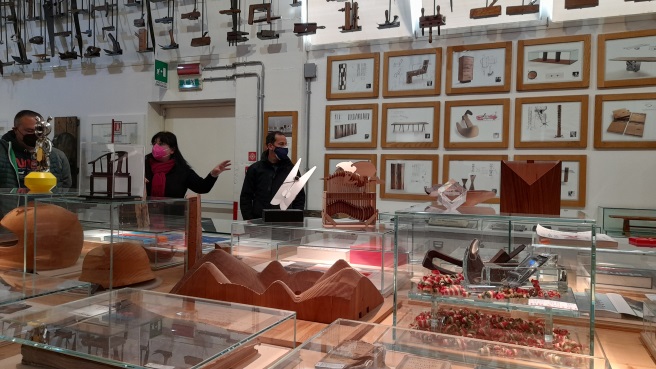
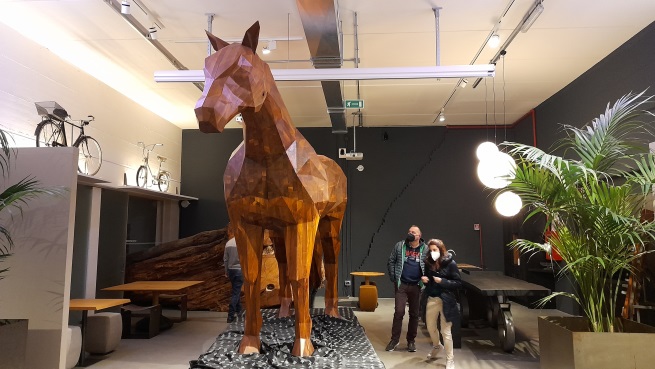
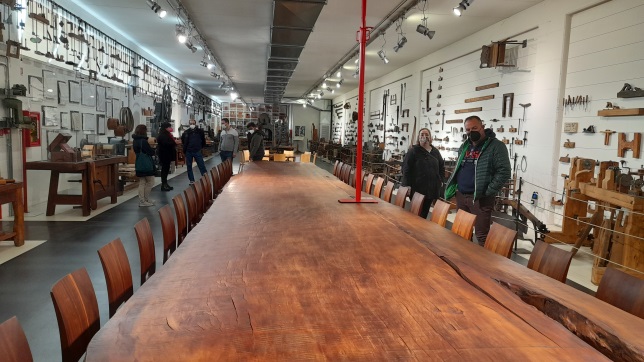
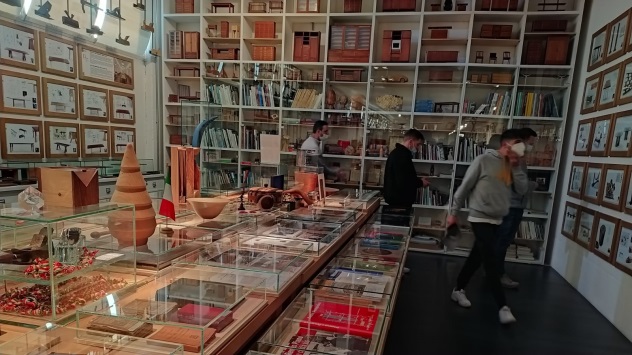
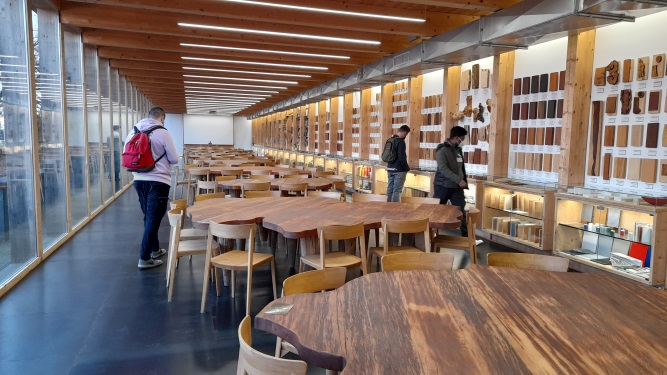
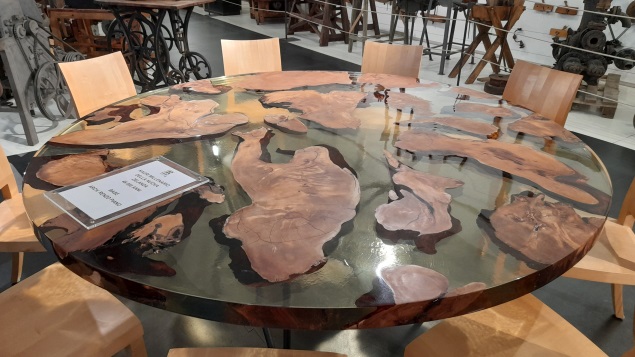
It is worth noting the existence of tables made of very old wood. The centrepiece of this space is the Antico table, 12 meters of 48,000-years-old Kauri wood from New Zealand , with an iron base designed by the architect Renzo Piano.
Visit to the Milan polytechnic
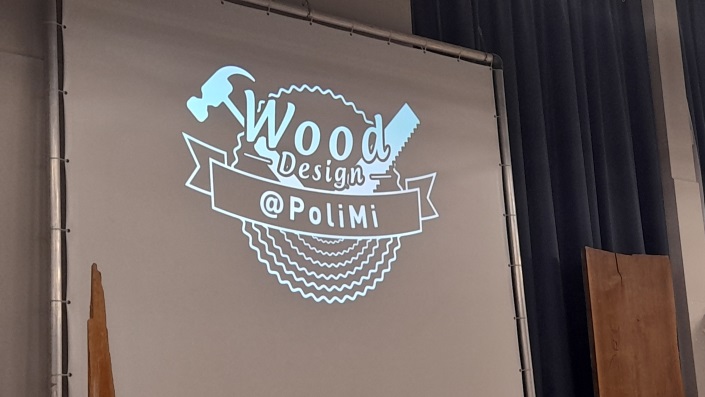
The group visited one of the world’s leading universities for DESIGN studies in all its dimensions. The SMARTRAIN project group visited the laboratory of the Wood Design course, as well as other laboratories of the School of Design. The person in charge of the subject explained the activities that carried out, design strategies, concepts, etc. of great interest for the whole group. A Colombian student of the Master’s in Design, specialised in the field of service design, told the group her personal story until she came to study in this centre and gave the students valuable advice about the existing possibilities.
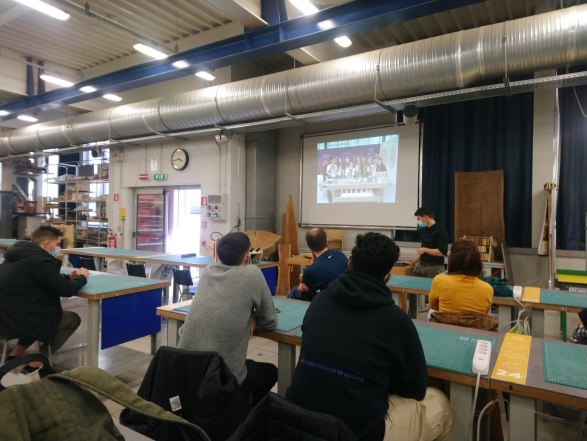
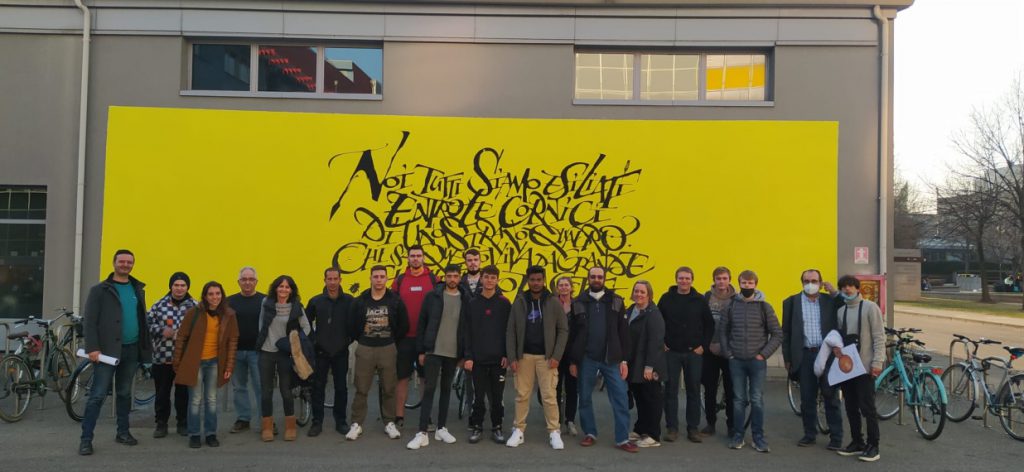
It has been a very interesting mobility in terms of group and collaborative work, progress in certain aspects of the projects of the three groups, and a series of very enriching visits in terms of possibilities, ideas, materials, designs, to incorporate in their projects, etc.
The consortium, especially the Spanish group, showed the draft of the mobility planning to be held in May in Spain, which is preparing agenda schedule of activities focused on the final progress of the projects, f smart furniture concepts, and a series of visits to several companies of interest for the objectives of the SMARTRAIN project.
SMARTRAIN. BRIDGING PIVOTAL COMPETENCIES FROM VET CURRICULA TO CO-CREATION IN FURNITURE DESIGN

Project Number: 22000050
Grant Agreement: 2020-1-ES01-KA202-082778
Duration: From 01/10/2020 to 30/09/2022
Coordinated at AIDIMME by: SORIANO CARDO, CARLOS
R&D Line: INDUSTRY 4.0
For more information, contact AIDIMME.
Visitors: [wpstatistics stat=pagevisits time=total id=27431]